Sunday, March 7, 2021

CIA Model

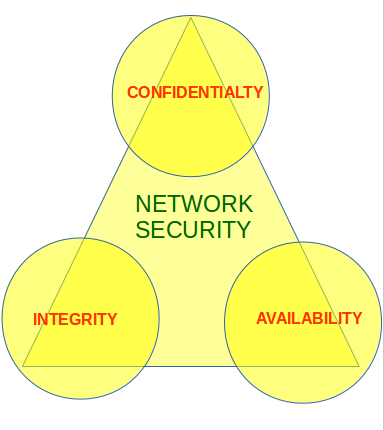
Confidentiality, integrity and availability, also known as the CIA triad, is a model designed to guide policies for information security within an organization. The model is also sometimes referred to as the AIC triad (availability, integrity and confidentiality) to avoid confusion with the Central Intelligence Agency. Although elements of the triad are three of the most foundational and crucial cyber-security needs, experts believe the CIA triad needs an upgrade to stay effective.

In this context, confidentiality is a set of rules that limits access to information, integrity is the assurance that the information is trustworthy and accurate, and availability is a guarantee of reliable access to the information by authorized people.

Confidentiality, integrity, availability

The following is a breakdown of the three key concepts that form the CIA triad:

  • Confidentiality is roughly equivalent to Confidentiality measures are designed to prevent sensitive information from unauthorized access attempts. It is common for data to be categorized according to the amount and type of damage that could be done if it fell into the wrong hands. More or less stringent measures can then be implemented according to those categories.
  • Integrity involves maintaining the consistency, accuracy and trustworthiness of data over its entire life-cycle. Data must not be changed in transit, and steps must be taken to ensure data cannot be altered by unauthorized people (for example, in a breach of confidentiality).
  • Availability means information should be consistently and readily accessible for authorized parties. This involves properly maintaining hardware and technical infrastructure and systems that hold and display the information.


Why the CIA triad is important

With each letter representing a foundational principle in cyber-security, the importance of the CIA triad security model speaks for itself. Confidentiality, integrity and availability together are considered the three most important concepts within information security.

Considering these three principles together within the framework of the "triad" can help guide the development of security policies for organizations. When evaluating needs and use cases for potential new products and technologies, the triad helps organizations ask focused questions about how value is being provided in those three key areas.

Thinking of the CIA triad's three concepts together as an interconnected system, rather than as independent concepts, can help organizations understand the relationships between the three.

Examples of the CIA triad

Here are examples of the various management practices and technologies that comprise the CIA triad. While many CIA triad cyber-security strategies implement these technologies and practices, this list is by no means exhaustive.

Confidentiality

Sometimes safeguarding data confidentiality involves special training for those privy to sensitive documents. Training can help familiarize authorized people with risk factors and how to guard against them. Further aspects of training may include strong passwords and password-related best practices and information about social engineering methods to prevent users from bending data-handling rules with good intentions and potentially disastrous results.

A good example of methods used to ensure confidentiality is requiring an account number or routing number when banking online. Data encryption is another common method of ensuring confidentiality. User IDs and passwords constitute a standard procedure; two-factor authentication (2FA) is becoming the norm. Other options include bio-metric verification and security tokens, key fobs or soft tokens. In addition, users can take precautions to minimize the number of places where information appears and the number of times it is actually transmitted to complete a required transaction. Extra measures might be taken in the case of extremely sensitive documents, such as storing only on air-gapped computers, disconnected storage devices or, for highly sensitive information, in hard-copy form only.

Integrity

These measures include file permissions and user access controls. Version control may be used to prevent erroneous changes or accidental deletion by authorized users from becoming a problem. In addition, organizations must put in some means to detect any changes in data that might occur as a result of non-human-caused events such as an electromagnetic pulse (EMP) or server crash.

Data might include checksum, even cryptographic checksum, for verification of integrity. Backups or redundancies must be available to restore the affected data to its correct state. Furthermore, digital signatures can be used to provide effective non-repudiation measures, meaning evidence of logins, messages sent, electronic document viewing and sending cannot be denied.

Availability

This is best ensured by rigorously maintaining all hardware, performing hardware repairs immediately when needed and maintaining a properly functioning operating system (OS) environment that is free of software conflicts. It's also important to keep current with all necessary system upgrades. Providing adequate communication bandwidth and preventing the occurrence of bottlenecks are equally important tactics. Redundancy, fail-over, RAID -- even high-availability clusters -- can mitigate serious consequences when hardware issues do occur.

Fast and adaptive disaster recovery is essential for the worst-case scenarios; that capacity relies on the existence of a comprehensive DR plan. Safeguards against data loss or interruptions in connections must include unpredictable events such as natural disasters and fire. To prevent data loss from such occurrences, a backup copy may be stored in a geographically isolated location, perhaps even in a fireproof, waterproof safe. Extra security equipment or software such as firewalls and proxy servers can guard against downtime and unreachable data blocked by malicious denial-of-service (DoS) attacks and network intrusions.

Special challenges for the CIA triad

Big data poses challenges to the CIA paradigm because of the sheer volume of information that organizations need safeguarded, the multiplicity of sources that data comes from and the variety of formats in which it exists. Duplicate data sets and disaster recovery plans can multiply the already-high costs. Furthermore, because the main concern of big data is collecting and making some kind of useful interpretation of all this information, responsible data oversight is often lacking. Whistle blower Edward Snowden brought that problem to the public forum when he reported on the National Security Agency's collection of massive volumes of American citizens' personal data.

Internet of things privacy protects the information of individuals from exposure in an IoT environment. Almost any physical or logical entity or object can be given a unique identifier and the ability to communicate autonomously over the internet or a similar network. The data transmitted by a given endpoint might not cause any privacy issues on its own. However, when even fragmented data from multiple endpoints is gathered, collated and analyzed, it can yield sensitive information.

Internet of things security is also challenging because IoT consists of so many internet-enabled devices other than computers, which often go unpatched and are often configured with default or weak passwords. Unless adequately protected, IoT could be used as a separate attack vector or part of a thingbot.

As more and more products are developed with the capacity to be networked, it's important to routinely consider security in product development.

Best practices for implementing the CIA triad

In implementing the CIA triad, an organization should follow a general set of best practices. Some best practices, divided by each of the three subjects, include:

Confidentiality

  • Data should be handled based on the organization's required privacy.
  • Data should be encrypted using 2FA.
  • Keep access control lists and other file permissions up to date.

Integrity

  • Ensure employees are knowledgeable about compliance and regulatory requirements to minimize human error.
  • Use backup and recovery software.
  • To ensure integrity, use version control, access control, security control, data logs and checksum.

Availability

  • Use preventive measures such as redundancy, fail-over and RAID. Ensure systems and applications stay updated.
  • Use network or server monitoring systems.
  • Ensure a data recovery and business continuity (BC) plan is in place in case of data loss.

The CIA triad in Cryptography

When talking about network security, the CIA triad is one of the most important model which is designed to guide policies for information security within an organization.

CIA stands for :

  1. Confidentiality
  2. Integrity
  3. Availability

These are the objectives which should be kept in mind while securing a network.

Confidentiality :

Confidentiality means that only the authorized individuals/systems can view sensitive or classified information. The data being sent over the network should not be accessed by unauthorized individuals. The attacker may try to capture the data using different tools available on the Internet and gain access to your information. A primary way to avoid this is to use encryption techniques to safeguard your data so that even if the attacker gains access to your data, he/she will not be able to decrypt it. Encryption standards include AES(Advanced Encryption Standard) and DES (Data Encryption Standard). Another way to protect your data is through a VPN tunnel. VPN stands for Virtual Private Network and helps the data to move securely over the network.


Integrity :

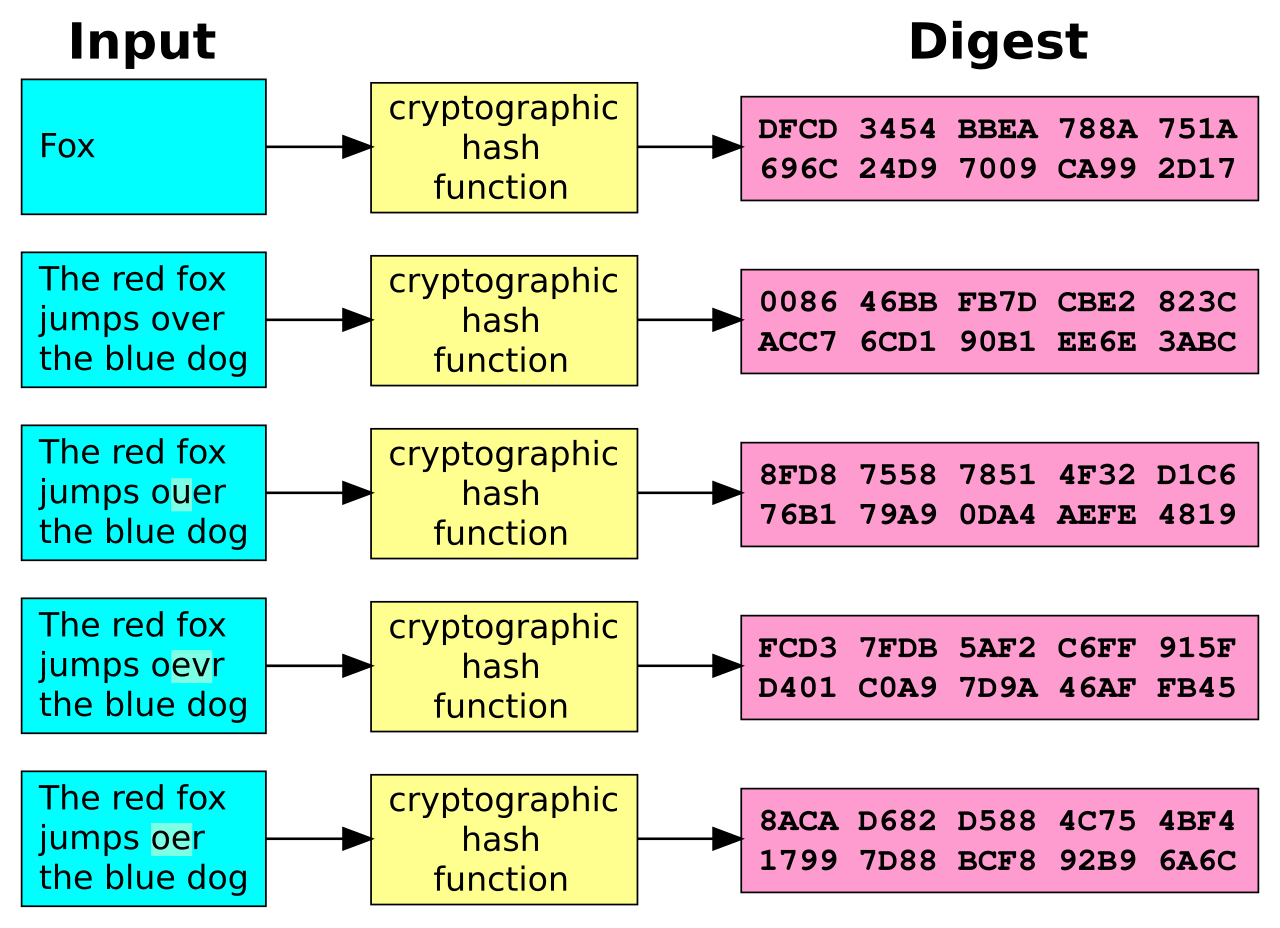
The next thing to talk about is integrity. Well, the idea here is making sure that data has not been modified. Corruption of data is a failure to maintain data integrity. To check if our data has been modified or not, we make use of a hash function.
We have two common types : SHA (Secure Hash Algorithm) and MD5(Message Direct 5). Now MD5 is a 128-bit hash and SHA is a 160-bit hash if we’re using SHA-1. There are also other SHA methods that we could use like SHA-0, SHA-2, SHA-3.

Let’s assume Host ‘A’ wants to send data to Host ‘B’ maintaining integrity. A hash function will run over the data and produce an arbitrary hash value H1 which is then attached to the data. When Host ‘B’ receives the packet, it runs the same hash function over the data which gives a hash value H2. Now, if H1 = H2, this means that data’s integrity has been maintained and the contents were not modified.


Availability :

This means that the network should be readily available to its users. This applies to systems and to data. To ensure availability, the network administrator should maintain hardware, make regular upgrades, have a plan for fail-over and prevent bottleneck in a network. Attacks such as DoS or DDoS may render a network unavailable as the resources of the network gets exhausted. The impact may be significant to the companies and users who rely on the network as a business tool. Thus, proper measures should be taken to prevent such attacks.


Monday, March 1, 2021

Random Facts You Won't Believe

"Don't Forget to Follow My Blog Thanks☺"

Interesting Facts You didn't even know about

1. Kangaroos Can not walk backwards.

2. Want chocolate smelling poo?  There is a pill for that.

3. The shortest war in history lasted for only 38 minutes.

4. Sea Lions have rhythm.  They are the only animal able to clap to a beat.

5. While you sleep you can’t smell anything – even really, really bad or potent smells.

6. Some tumors can grow hair, teeth, bones, even fingernails.

7. Your brain uses 10 watts of energy to think and does not feel pain.

8. Glass balls can bounce higher than rubber ones.

9. Hippopotamus milk is pink.

10. Your fingernails grow faster when you are cold.


Friday, February 26, 2021

14 Most Interesting Facts

 " Don't Forget to Follow the Blog for more interesting facts and to win a monthly Netflix Subscription (Standard)"

1. There are more possible iterations of a game of chess than there are atoms in the known universe. — abbazabbbbbbba
chess
Enoch Lau

2. Cleopatra lived closer in time to the Moon landing than to the construction of the Great Pyramid of Giza. — StickleyMan 
cleopatra
Napoleon Sarony

3. It can take a photon 40,000 years to travel from the core of the sun to the surface, but only 8 minutes to travel the rest of the way to earth. — Bkaps 
sun
NASA

4. It would take 1,200,000 mosquitoes, each sucking once, to completely drain the average human of blood. — Bat245 
mosquito
Jim Gathany
 

5. Basically anything that melts can be made into glass. You just have to cool off a molten material before its molecules have time to realign into what they were before being melted. — cowboy-up 
glass
Gilles Tran

6. A small percentage of the static you see on "dead" tv stations is left over radiation from the Big Bang. You're seeing residual effects of the Universe's creation. — FanInTheCorner  
static
Paul Lim

7. Written language was invented independently by the Egyptians, Sumerians, Chinese, and Mayans. — NumberMuncher  
hieroglyphics
Ad Meskens

8. If you were to remove all of the empty space from the atoms that make up every human on earth, the entire world population could fit into an apple. — TheSicilianDude 
fuji apple
Scott Bauer
 

9. Honey does not spoil. You could feasibly eat 3000 year old honey. — Bluecheezeplatter 
honey
Waugsberg
 

10. If you somehow found a way to extract all of the gold from the bubbling core of our lovely little planet, you would be able to cover all of the land in a layer of gold up to your knees. — 
gold
Reno Chris

11. To know when to mate, a male giraffe will continuously headbutt the female in the bladder until she urinates. The male then tastes the pee and that helps it determine whether the female is ovulating. — Sir_Ostrich 
giraffe
Hans Hillewaert

12. The Spanish national anthem has no words. — ricick 
spanish flag
Anomie

13. The state sport of Maryland is jousting. — KdogCrusader 
jousting
Jeff Kubina

14. Dead people can get goose bumps. — 
goose bumps
Ildar Sagdejev

Thursday, February 25, 2021

RANDOM FACTS THAT YOU WON’T BELIEVE ARE TRUE

"Follow My Blog to get a chance to Win a monthly subscription of Netflix"


Giant Pandas eat approximately 28 pounds of bamboo a day – that’s over 5 tons per year!

The Nobel Peace Prize is named for Alfred Nobel, the inventor of dynamite.

Alfred Nobel

Cats are not able to taste anything that is sweet.

One of the ingredients needed to make dynamite is peanuts.

The largest living organism in the world is a fungus.  It is in Oregon, covering 2,200 acres and is still growing.

Fungus


"Stay Tuned Will Be Back With More Interesting And Fun Facts" 

Tuesday, February 23, 2021

General Knowledge Quiz USA


General Knowledge Quiz about the USA

Click the answer button to see the answer

  1. What are the two major parties in the US?.
    a. The Republicans and the Democrats.
    b. The Republics and the Socialists.
    c. The Democrats and the Socialists.
    d. The Conservationists and the Democrats.

  2. How many states are there in the US?.
    a. 49
    b. 50
    c. 51
    d. 48

  3. What do Americans celebrate on July 4th?
    a. Flag Day.
    b. The Revolution.
    c. The Discovery of America.
    d. Independence Day.

  4. In which year was the independence from England declared?
    a. 1776
    b. 1876
    c. 1676
    d. 1778

  5. Which president freed the slaves?.
    a. Thomas Jefferson
    b. George Washington
    c. Abrahan Lincoln
    d. Henry Ford

  6. Who was the civil rights leader who fought through nonviolent action?
    a. Thomas Paine
    b. Martin Luther King Jr.
    c. John Kennedy

  7. Who was the first person to walk on the moon?
    a. John Glenn
    b. Jim Lowell
    c. Neil Armstrong

  8. What was the name of the ship that brought the Pilgrims to New England in 1620?
    a. Pitta
    b. Sunflower
    c. Mayflower

  9. Where's the White House located?
    a. New York
    b. Washington, D.C.
    c. Houston

  10. What organization tries to find solutions to world problems and disputes?
    a. The United Nations
    b. IMF
    c. UNICEF
    d. Green Peace

  11. What does IMF stand for?
    a. International Monetary Foundation
    b. International Monetary Fund
    c. Internal Monetary Foundation
    d. Internal Monetary Fund

  12. Who said: 'We hold these truths to be self evident that all men are created equal'?
    a. Bill Clinton
    b. George Washington
    c. Richard Nixon
    d. Thomas Jefferson

  13. Who is eligible for the Office of President?
    a. Anyone whose children are American
    b. Whoever served the army
    c. A natural born citizen
    d. An alien

  14. When was the nineteenth amendment to the Constitution giving women the right to vote ratified?
    a. 1938
    b. 1920
    c. 1968
    d. 1960

Sunday, February 21, 2021

MS Excel


What is Excel?

Microsoft Excel is a helpful and powerful program for data analysis and documentation. It is a spreadsheet program, which contains a number of columns and rows, where each intersection of a column and a row is a “cell.” Each cell contains one point of data or one piece of information. By organizing the information in this way, you can make information easier to find, and automatically draw information from changing data.


The Excel Interface

File Tab & Ribbon

In Excel 2010, the Office button Office Button has been replaced by a modification of the familiar File menu File button. Click to reveal the New, Open, Save, Print and Close options.

If you are upgrading to 2010 from 2007, not much of the interface has changed.  However, if you are upgrading from an older version of Excel, you may be unfamiliar with the new interface, which will be explained in the sections below. Seven tabs are displayed across the top-left of the window. When you select a tab, a number of options will be displayed as buttons with text labels and picture icons for easy identification. The tabs and their options are known as the Ribbon. The options are organized under the tabs in groups of related features. You can expand the groups by clicking the arrow Group Arrow in the right of the group box.

Home Tab

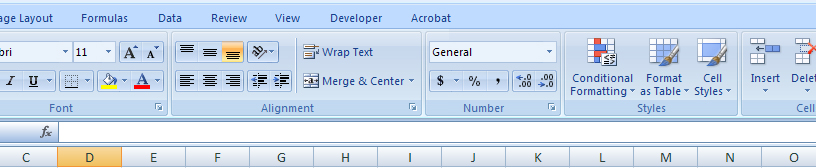
The Home tab contains the most common text editing tools used in Excel.

hometab
 
Shortcut Menu

The most common Excel commands and functions can be accessed quickly by using the shortcut menu. To access this feature, simply right-click the element you wish to edit if you are using a PC, or control-click the element you wish to edit if you are using a Mac. The options displayed will vary depending on the element you have selected.

Spreadsheet Basics

Each Excel file is a workbook that can hold many worksheets. The worksheet is a grid of columns (designated by letters) and rows (designated by numbers). The letters of the columns are indicated in the blue buttons across the top of the worksheet. The numbers of the rows are indicated in the blue buttons down the left of the worksheet. The intersection of a column and a row is called a cell. You can input your data into the cells. Cells can contain text, numbers, or formulas for automatic calculations. Each cell on the spreadsheet has a cell address that is the column letter followed by the row number.

Formula bar

This will be one of the most useful tools as you use Excel. The formula bar allows you to see all the details and methods used to return what is seen in a cell. Whenever you input any information into a cell, the output, or end result is what is shown once you move away from the cell. This is most prominent when using functions, as you do not see the whole equation in the cell in the worksheet, only the result. The formula bar is located below the ribbon and spans most of the window.

formula_bar

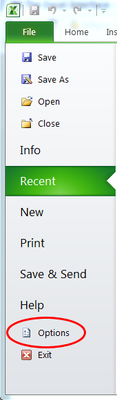
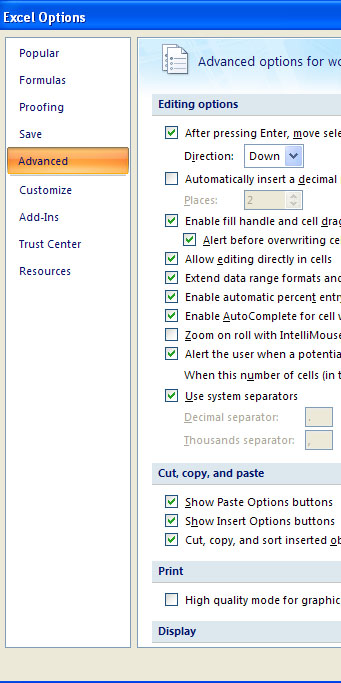
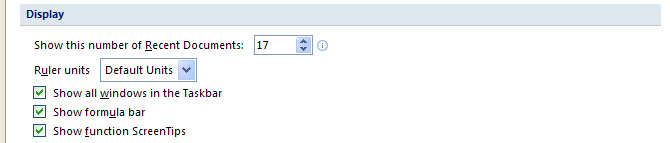
It is possible to hide the formula bar, though is not recommended. In order to hide or show the formula bar if it has mistakenly been hidden, go to Excel Options at the bottom right of the menu that opens when you click the Office button. Go to the Advanced option, and under Display, you can click the check box for Show formula bar. When done, simply click Ok.

options   excel_options_advanced
show_formula_bar

Adding a Worksheet

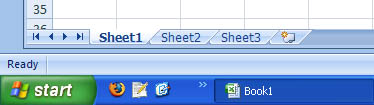
By default, three worksheets are included in each Excel workbook. You can access the different worksheets by clicking the worksheet tabs just above the status bar.

Worksheet Tabs

To add a new worksheet, click the Insert Worksheet tab, to the right of the existing worksheet tabs.

Renaming a Worksheet

To rename a worksheet tab, follow either of these steps:

  1. StepsActions
  2. Option 1
    1. Right-click the tab you want to rename if you are using a PC, or control-click the tab you want to rename if you are using a Mac. A shortcut menu will open.
    2. Click Rename from the shortcut menu.
    3. Type the new name.
    4. Press .
  3. Option 2
    1. Hover over the tab you want to rename, and double Left-click the tab.
    2. Begin typing to rename the tab.
    3. Press .


Basics


This section explains the basics of Excel.

Ribbon: Excel selects the ribbon's Home tab when you open it. Learn how to use the ribbon.

Workbook: A workbook is another word for your Excel file. When you start Excel, click Blank workbook to create an Excel workbook from scratch.

Worksheets: A worksheet is a collection of cells where you keep and manipulate the data. Each Excel workbook can contain multiple worksheets.

Format Cells: When we format cells in Excel, we change the appearance of a number without changing the number itself.

Find & Select: Learn how to use Excel's Find, Replace and Go To Special feature.

Templates: Instead of creating an Excel workbook from scratch, you can create a workbook based on a template. There are many free templates available, waiting to be used.

Data Validation: Use data validation in Excel to make sure that users enter certain values into a cell.

Keyboard Shortcuts: Keyboard shortcuts allow you to do things with your keyboard instead of your mouse to increase your speed.

Print: This chapter teaches you how to print a worksheet and how to change some important print settings in Excel.

10 Share: Learn how to share Excel data with Word documents and other files.

11 Protect: Encrypt an Excel file with a password so that it requires a password to open it.


Click Here for formulas


THAT TROPICANA FEELING

  What is Tropicana?  Well, it's 100% pure-squeezed orange juice. And it's also the feeling of pure, natural joy.  #ThatTropicinaF...